Table of contents
- 1. You’re Creating for Yourself, Not Your Audience
- 2. Your Hook Is Losing People in 2 Seconds
- 3. Posting at the Wrong Time for the Wrong Platform
- 4. Your CTA Is Missing or It’s Doing Too Much
- 5. Why Instagram Creators Ignore Content Distribution
- 6. Your Content Doesn’t Invite a Conversation
- 7. How to Audit and Fix Your Existing Content Right Now
- Final Thoughts
- Frequently Asked Questions
Understanding the real reasons for low content engagement and knowing how to boost content engagement from what you already have is the difference between growing and just posting, and this article breaks down exactly what’s hurting you.
1. You’re Creating for Yourself, Not Your Audience
This is the number one content engagement mistake to avoid and the one nobody wants to hear. When you make content that you find interesting, you find aesthetic, or you feel proud of, you’re optimizing for the wrong person. Your audience doesn’t care how long you spent on that Canva design.
What they care about is: does this solve my problem, entertain me, or make me feel something? That’s it. Common causes of poor post-performance almost always trace back to a disconnect between what the creator wants to say and what the audience actually wants to consume.
Before you create anything, ask: ‘What will my audience DO after seeing this?’ If the answer is nothing, rethink it. Content that prompts action (a save, a share, a comment, a click) is built intentionally around the audience’s world, not the creator’s.

2. Your Hook Is Losing People in 2 Seconds
Social media platforms such as Instagram, TikTok, LinkedIn, X all share one brutal truth: you have about 1.7 seconds to stop the scroll. If your opening line, thumbnail, or first video frame doesn’t create a reason to stop, your content is already dead before it gets a fair shot.
This is one of the biggest factors hurting social media reach that polished content ignores.
Weak hooks sound like: Here is a thread about marketing. Strong hooks sound like: I grew from 400 to 40,000 followers in 90 days and never bought a follower. Here is the boring truth. See the difference? One is an announcement and the other is a story with stakes.
Your hook needs to do one of three things:
- Create curiosity
- Promise a specific outcome
- Trigger an immediate emotion.
High-quality posts with zero traction are almost always suffering from a weak opening, not weak content underneath it. Nail the hook first; the rest has a fighting chance.
3. Posting at the Wrong Time for the Wrong Platform
Platform timing is a content engagement mistake to avoid that feels minor but compounds brutally over time. Posting your best content when your audience is offline means Instagram, LinkedIn, or TikTok never gets enough early signal to distribute it and the post quietly dies in the first hour.
Each platform has its own rhythm. According to Hootsuite’s 2024 Best Time to Post data, Instagram engagement peaks between 9–11am and 7–9pm on weekdays. LinkedIn rewards morning posts (7–9am) from Tuesday to Thursday.
TikTok is most active between 6 and 10pm. These windows aren’t universal, but they’re where most audiences are.
The practical move: check your platform’s native analytics for your specific audience’s active hours. Then post 15–30 minutes before the peak, not during, so the early engagement wave catches the algorithm at full tide. This alone can flip poor post-performance on otherwise solid content.
4. Your CTA Is Missing or It’s Doing Too Much
Every piece of content needs one clear call to action. One, not five and not zero. When you end a post with Follow, like, share, comment, save, and click the link in bio! you have paralyzed your audience with options, and they choose none. This is a classic issue with low audience interaction that is 100% fixable.
The same goes for missing CTAs entirely. Beautiful content with no direction teaches your audience to admire and scroll. You need to ask for the specific action you want. Save this for later. Drop your answer below. Tag someone who needs this.
These are not pushy they are guides and people follow instructions when it is clear and low-effort.
5. Why Instagram Creators Ignore Content Distribution
Creating content and hoping the algorithm delivers it is not a distribution strategy. That’s called wishing. The hard truth about why content performs poorly despite quality is often that distribution was never planned at all.
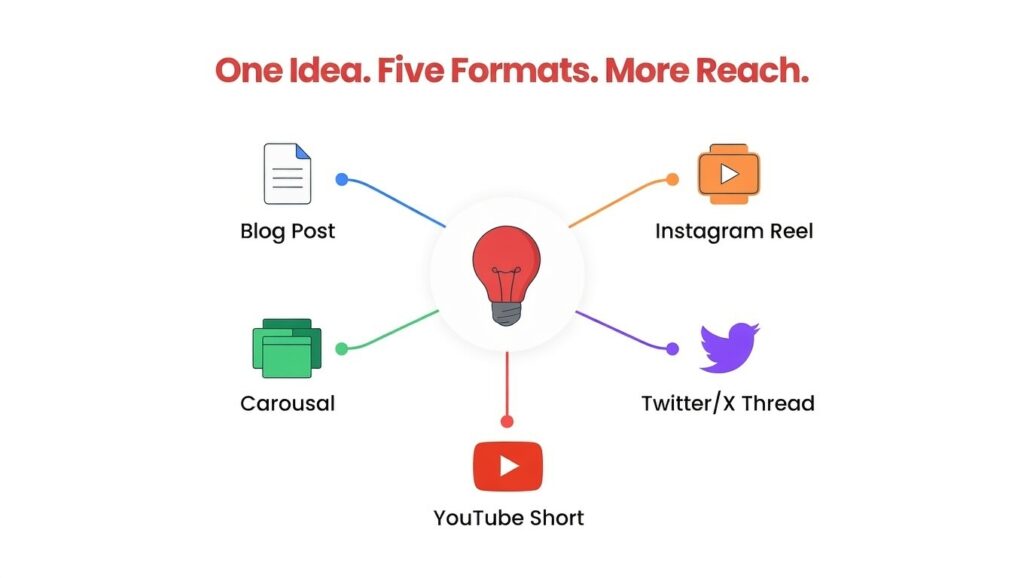
Distribution means actively putting your content in front of people beyond your existing followers. That includes: sharing your post to Stories, cross-posting to relevant communities or groups, linking your content inside related articles (like this guide on building a high-converting website in Nigeria), or even repurposing the same idea across multiple formats and platforms.
Gary Vaynerchuk calls this the document-do not-create principle and at its core it means one idea should travel in as many forms as possible. A blog post becomes a Reel. A Reel becomes a carousel. A carousel becomes a Twitter/X thread. Good content ignored by audience is often content that never left its original home. Repurpose articles for better reach and stop leaving distribution to chance.
6. Your Content Doesn’t Invite a Conversation
Here’s one of the most overlooked strategies for higher engagement rates: stop broadcasting and start conversing. Content that performs well on social media almost always has an element of open-endedness: it invites the audience into a dialogue, not just a monologue.
Think about the difference between posting 5 tips for better sleep versus The one sleep habit that changed my mornings, what is yours? The second one asks a question. It creates a space for your audience to insert themselves. That is what drives comments and comments are one of the heaviest engagement signals across every major platform right now.
This is also how you revive old posts for more views. Go back to your top-performing old content, drop a comment with a new question or a fresh angle, and pin it.
You’d be surprised how much traffic stirs back to life from content you wrote six months ago, just by reopening the dialogue. Fix stagnant content performance often, all it needs is a new conversation starter.
7. How to Audit and Fix Your Existing Content Right Now
You don’t need to start over. You need to improve engagement on existing content by auditing what’s already there.
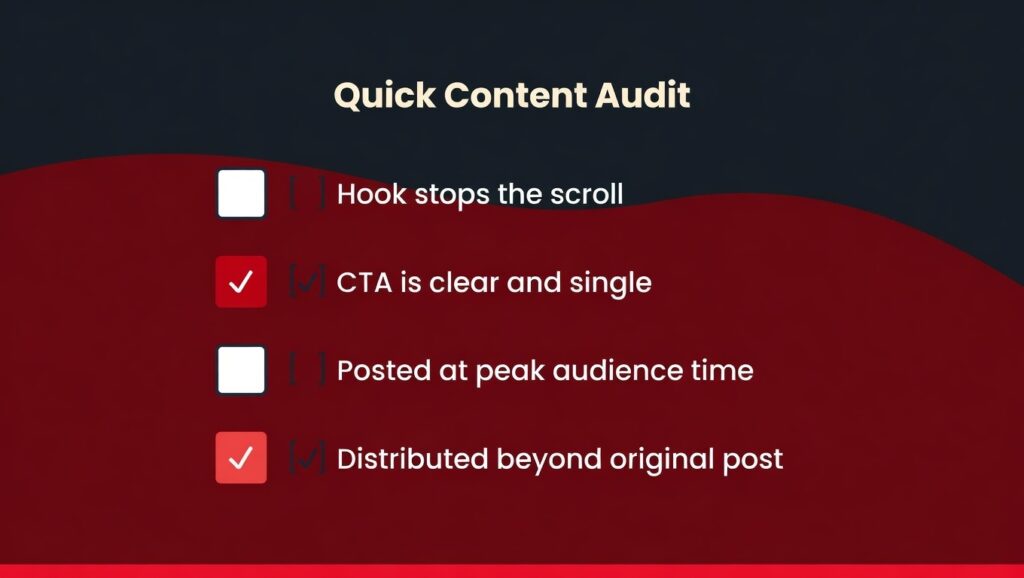
Here’s a quick system:
Pull your last 20 posts. Sort them by saves and shares not likes. Find the top 3 and study why they outperformed.
Check the hook on every underperforming post. Would you stop scrolling? Be honest.
Add or fix the CTA. One clear ask per post. Update captions on older posts where possible.
Repurpose the top performers. Turn that blog post into a Reel. Applying smart digital tools can help you identify which content has repurposing potential fastest.
Update old posts with fresh context. A post from 2023 about Instagram trends? Refresh the stats, add a 2025 angle, and update content to boost shares organically.
Also see: How to Turn Your Website Into a 24/7 Sales Machine, the same content-first principles that work on social media apply directly to your website’s conversion architecture.
Final Thoughts
The reasons for low content engagement are almost never about quality. They’re about audience understanding, hook strength, timing, distribution, and the presence (or absence) of a clear CTA.
The good news? Every single content engagement mistake in this article is fixable and most of them are fixable today, on content you’ve already published. Start with your best post from the last 3 months.
Sharpen the hook, fix the CTA, redistribute it, and reopen the conversation and if you need your numbers to reflect the work you’re putting in, Sizzle Social is Nigeria’s platform built specifically to give your content the engagement signal it deserves while your organic strategy catches up.
The gap between good-looking content and content that actually performs is where most creators and brands in Nigeria get stuck.
Understanding the real reasons for low content engagement and knowing how to boost content engagement from what you already have is the difference between growing and just posting, and this article breaks down exactly what’s hurting you.
Frequently Asked Questions
Good visuals are only one piece of the puzzle. The most common reasons well-designed content gets low engagement are: a weak or generic hook that fails to stop the scroll, posting at the wrong time when your audience is offline, no clear call to action telling people what to do next, and content that speaks to you rather than your specific audience. Great design earns a glance but only relevant, audience-first content earns a like, save, or share. Audit your hook and CTA before assuming the content itself is the problem.
There are several effective ways to improve engagement on existing content without deleting it. First, go back and edit the caption to add a stronger CTA or a direct question to spark comments. Second, re-share the post to your Stories with a poll or question sticker attached. Third, drop a new comment under the post to re-trigger algorithmic attention. Fourth, repurpose the best-performing content into a new format turn a blog post into a Reel or a carousel into a thread. Refreshing old content with updated stats or a new angle also helps significantly.
The top content engagement mistakes include: creating content based on your preferences rather than your audience’s needs, using weak or absent hooks that fail to stop the scroll in the first 1–2 seconds, posting without a single clear call to action, ignoring platform-specific timing and algorithmic patterns, treating every platform identically instead of adapting content format per channel, and failing to distribute content beyond its original post. Each of these mistakes individually reduces performance combined, they explain why even well-produced content consistently underperforms its potential reach.
Quality content can fail for several reasons that have nothing to do with the content itself. If your audience doesn’t see it (distribution failure), if it doesn’t stop them fast enough (hook failure), if it doesn’t prompt action (CTA failure), or if it doesn’t match what your audience actually needs at this moment (relevance failure), it will underperform regardless of production value. High-quality posts with zero traction are most often a timing, distribution, or audience-alignment problem, not a content quality problem. Diagnose these areas before investing more in design or copywriting
Yes! significantly. Every social media platform uses early engagement signals (likes, comments, shares in the first 30–60 minutes) to determine how widely to distribute content. If you post when your audience is asleep or at work, your post receives little early engagement, and the algorithm interprets this as low-quality content. It then limits distribution. Platforms like Instagram, TikTok, and LinkedIn all have identifiable peak engagement windows. Check your native analytics to find YOUR audience’s most active hours not generic advice and consistently post 15–30 minutes before those windows
The most effective CTAs are specific, low-effort, and contextually relevant to the content. Instead of ‘like and follow,’ try: ‘Save this for when you need it,’ ‘Drop your answer in the comments,’ ‘Tag someone who needs to see this,’ or ‘Share this to your Stories if this hit different.’ Each of these asks for one specific action that requires minimal effort but registers as a strong engagement signal with the algorithm. Avoid stacking multiple CTAs in one post this creates decision paralysis and typically results in the audience taking no action at all.
Start by identifying your top 5 posts from the last 6–12 months sorted by saves and shares, not likes. For each one, consider: can this be reformatted as a Reel or short video? Can the core idea be expanded into a carousel? Can the data or tips be turned into a LinkedIn article? Can you revisit the topic with updated information for 2025? Repurposing is not copying it is redistributing a proven idea in a new format that serves a different audience behavior. Each repurposed format is a new opportunity for engagement and discovery.
High reach with low engagement usually means people are seeing your content but not connecting with it enough to act. This is a relevance or hook problem. Your content may be reaching the right number of people but the wrong people or the right people who aren’t compelled enough to respond. Audit your content for: audience-specific language and context, a hook that creates genuine curiosity or emotion, content that asks something of the reader or viewer, and a CTA that makes the next step obvious. Reach without engagement is a signal mismatch, not a volume problem.
Consistency is one of the most underrated drivers of long-term content engagement. Posting irregularly trains both your audience and the algorithm to deprioritize your content. When followers can’t predict when you’ll show up, they disengage over time and algorithms on every major platform reward accounts that post regularly with stronger organic distribution. Consistency doesn’t mean posting daily. It means establishing a reliable cadence your audience can expect. Whether that’s 3 times a week or daily, the key is showing up on schedule and maintaining quality across that schedule.
Absolutely and starting from scratch is rarely necessary. Most underperforming content just needs a strategic adjustment, not a full rebrand. Begin by auditing your existing posts: fix captions with stronger hooks and clearer CTAs, re-share top-performing old content with a fresh angle, and repurpose your best ideas into new formats. If distribution was the problem, actively share your posts to Stories, communities, or relevant groups. If timing was the issue, shift your posting window. Low engagement is a solvable problem at the tactical level no content calendar overhaul required.