Table of contents
- Effective Testimonial Strategies That Actually Drive Sales in Nigeria
- How to Leverage User-Generated Content Quickly to Build Buyer Trust
- Real-Time Social Proof Notifications: How to Create Buying FOMO in Nigeria
- Trust Badges and Review Widgets That Make Nigerian Buyers Feel Safe to Pay
- Influencer and Expert Endorsements: The Fastest Credibility Shortcut in Nigeria
- Final Thoughts
- Frequently Asked Questions
A Nigerian skincare brand in Ikeja once ran the same Facebook ad for three months, beautiful product photography, compelling copy, competitive pricing.
But the sales? Flat. Then a customer posted an unboxing video on Instagram showing her skin transformation after two weeks of use. The founder reposted it in her Stories. Within 48 hours, the product sold out.
Same product. Same price. Different result, because this time, a real person said it works.
That is the raw, unfiltered power of social proof. And in Nigeria, where “I hear say” has always mattered more than any billboard, the psychological weight of what others are doing, buying, and endorsing is enormous. According to a Nielsen Consumer Trust Report, 92% of consumers trust recommendations from people they know over brand advertising.
Yet most Nigerian businesses are spending all their budget on ads and zero on building the social proof that converts those ad viewers into buyers.
This guide breaks down the 5 most powerful, and most underused, social proof strategies for Nigerian e-commerce and product sellers in 2026.
From effective testimonial strategies for sales to leveraging user-generated content quickly, from real-time social proof notifications to trust badges and influencer endorsements, this is the playbook that turns visitors into buyers and browsers into believers.
One important note before diving in: social proof is only as effective as the platform it lives on. If your website is not built to convert, even the best testimonial will bounce off it. Understanding why most Nigerian business websites fail is as important as anything else in this guide.
Let’s get started.
Effective Testimonial Strategies That Actually Drive Sales in Nigeria

Most Nigerian sellers collect testimonials the wrong way. A customer says something nice in a DM, the seller screenshots it and throws it in a WhatsApp broadcast. Done. That is not a testimonial strategy, but a digital wishful thinking.
Effective testimonial strategies for sales require intentional collection, intentional placement, and intentional format, and the difference in conversion rates is not small.
According to Wyzowl’s 2024 Video Marketing Report, video testimonials boost conversions by up to 80% compared to text-only reviews. That is not a marginal improvement, that is the difference between a business that struggles and one that scales.
Despite that most Nigerian product sellers still rely exclusively on WhatsApp screenshot testimonials, which look informal and are easy to fake. Video testimonials boost conversions fast because they are hard to fabricate and carry the full emotional weight of a real person speaking.
Here is how to build a testimonial system that converts:
1. Ask immediately after the win: The best time to request a testimonial is right after the customer experiences a result, the skin cleared up, the course worked, the product arrived. Set a reminder to follow up 7-10 days after delivery. Most satisfied customers are willing to share if asked directly and promptly.
2. Give them a structure: A vague “say something nice” request produces vague results. Instead, ask: “In 2-3 sentences, describe what problem you had before, what happened after using the product, and who you’d recommend it to.” This structure automatically produces customer success stories that increase sales because they follow the exact narrative arc a buyer needs to hear.
3. Video first, text second: A 30-60 second WhatsApp voice note or video from a customer is infinitely more credible than a typed review. Offer a small incentive, a discount on the next order, in exchange for a short video testimonial. The ROI is immediate.
4. Display testimonials on landing pages strategically: Placement matters as much as the testimonial itself. Position your best testimonial directly above your buy button, not buried at the bottom of the page where nobody scrolls. Building a high-converting Nigerian business website means designing testimonial placement as a core conversion element, not an afterthought.
5. Rotating testimonial carousels on e-commerce pages: A rotating carousel of 6-10 diverse customer testimonials, different ages, genders, locations, problems solved, signals breadth of satisfied customers. It subconsciously answers the buyer’s unspoken question: “Did this work for someone like me?”
One more thing: authentic reviews that drive product purchases must feel real. Polished, overly edited testimonials, where everybody sounds like an ad copywriter, actually reduce trust. Keep them human. Keep them imperfect. Realness converts.
How to Leverage User-Generated Content Quickly to Build Buyer Trust
There is a phrase in marketing that is more true in Nigeria than anywhere else: “Your customers are your best content creators.”
When a buyer in Port Harcourt posts a photo wearing your fashion brand’s ankara dress, or a customer in Kano records a reaction video after trying your food product, that content is doing something your own marketing budget cannot fully buy: peer-to-peer authenticity. This is what leveraging user-generated content quickly is really about.
UGC (User-Generated Content) consistently outperforms branded content in conversion metrics. A 2023 Stackla Consumer Content Report found that UGC photos convert 29% better than stock photography on product pages. Nigerian consumers, who are naturally skeptical of polished brand claims after years of sub-standard products flooding the market, respond even more strongly to real customer content.
When they see someone who looks like them, lives like them, and buys what they’re considering, the resistance drops.
Here’s how to build a fast, effective UGC engine for your Nigerian brand:
- Create a branded hashtag and make it visible everywhere: Your packaging, your receipt, your order confirmation WhatsApp message, all should say “Tag us with #[YourBrandHashtag] and we’ll feature you.” A hashtag contest that generates social proof does not need a big prize. Recognition is often enough. Nigerians love being featured.
- Repost customer content consistently: Every week, feature a customer photo or video on your Instagram Stories, Reels feed, or WhatsApp Status. Reposting customer content for trust signals to prospective buyers that real people are buying and loving your product. It also incentivizes other customers to post, everyone wants their moment.
- Build an Instagram UGC feed: Dedicate a recurring segment of your Instagram grid to customer photos, clearly labeled as real customer submissions. An Instagram UGC feed that boosts sales creates a visual body of evidence that your product delivers. Growing a credible Instagram business page in Nigeria and populating it with UGC is one of the most effective trust-building strategies available at zero additional cost.
- Use UGC on product pages: If you have a website, embed customer-submitted user photos on product pages directly beneath the product description. Seeing a real Nigerian customer using the product removes the mental gap between browsing and buying.
Want more eyes on your brand’s social proof? Sizzle Social helps Nigerian businesses grow their social presence with real followers who actually engage. See reviews from brands that have already made the shift
The secret to making UGC work consistently is volume plus variety. One customer photo is a data point. Twenty customer photos from different demographics and locations is a movement. And a movement converts. If your engagement is lagging, understanding why your content looks good but still gets low engagement will show you how UGC fits into a larger content trust system.
Real-Time Social Proof Notifications: How to Create Buying FOMO in Nigeria
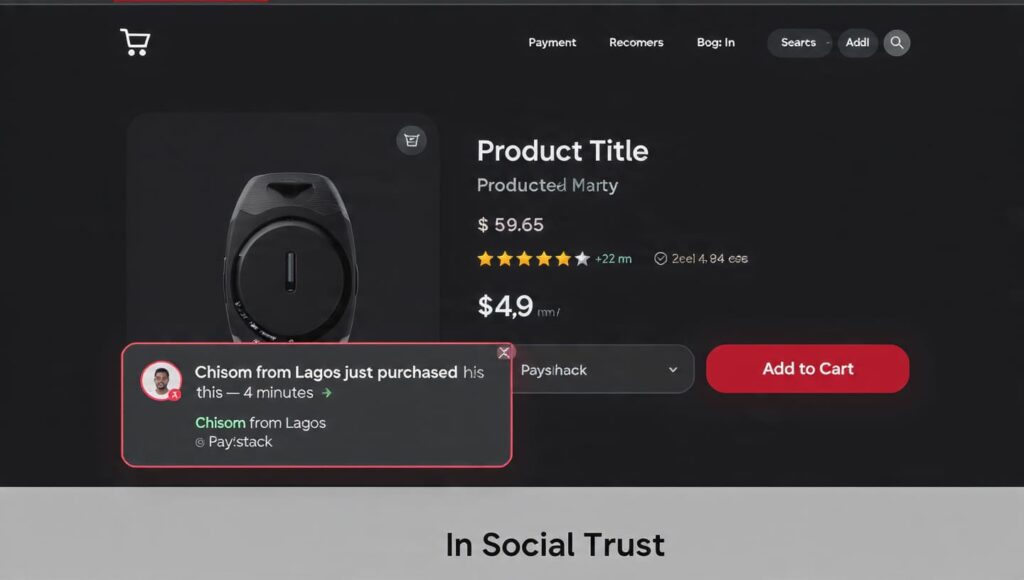
Have you ever been on a website, hovering over the buy button, not quite sure, and then a small popup appears in the corner saying: “Amaka from Abuja just purchased this 3 minutes ago.” And suddenly you clicked? That is real-time social proof doing exactly what it was designed to do. It is not manipulation, but information that resolves uncertainty.
And in the Nigerian online shopping context, where trust in e-commerce is still being earned, live purchase notifications that increase FOMO are among the highest-converting tools available.
For Nigerian businesses where cart abandonment rates run high due to payment trust issues, these recent buyer alert conversion tools can be the deciding factor between a bounce and a sale.
The logic is simple: if someone else just bought it, it must be safe to buy. That is human psychology at work, and it works universally.
Here’s how to implement real-time social proof effectively on your Nigerian online store:
- Install a social proof notification tool: Platforms like Fomo, ProveSource, and TrustPulse integrate with most Nigerian e-commerce platforms (Shopify, WooCommerce, Paystack Storefront). They automatically display “others bought this recently” popups using live transaction data. Setup takes under 30 minutes and the impact is immediate.
- Localize the notifications: A popup that reads “Tolu from Lekki just ordered this” converts better than “A customer from Nigeria just purchased.” Nigerian buyers respond to geographic and name-based familiarity, it signals that people like them, near them, are buying. This is the dynamic social proof widget at its most culturally effective.
- Show stock scarcity in real time: Combine purchase notifications with inventory countdowns, “Only 3 left in stock” shown alongside “8 people are viewing this right now”, and you have created a legitimate urgency loop that turns passive browsing into active purchasing.
- Display on checkout pages specifically: The highest-value place for real-time activity feeds at checkout is right beside the payment button. The moment a customer is deciding whether to complete the purchase, seeing that three other people completed the same action in the last hour removes the last objection. A conversion-optimized website for Nigerian businesses is built with exactly these friction-reduction tools in place.
One caution: only use real transaction data for these notifications. Fabricating fake activity is unethical and legally risky. But for any business with genuine daily sales, real-time social proof practically runs itself. Let your actual customers become your loudest conversion engine.
Trust Badges and Review Widgets That Make Nigerian Buyers Feel Safe to Pay
Many Nigerians have been burnt online before. A product ordered that never arrived. A payment made to a business that vanished. A skincare cream that turned out to be repackaged groundnut oil. This history of bad experiences has created a trust deficit in Nigerian e-commerce that no amount of flashy advertising can overcome on its own.
What overcomes it? Trust badges and review widgets, the visual signals that tell a buyer, before they even read a single word of your copy: “This place is safe. Others have paid here and survived.”
A Baymard Institute checkout study found that 17% of online shoppers abandon carts specifically because they don’t trust the site with their payment information.
In Nigeria, where card fraud anxiety is high and Paystack/Flutterwave adoption is still educating consumers, that number is likely higher. Security badges improve checkout rates by directly addressing this unspoken fear, they are not decorative, they are functional.
The trust badges and review placements that move Nigerian buyers:
- Payment security badges: Display Paystack, Flutterwave, Mastercard SecureCode, and Verified by Visa logos prominently on your checkout page and product pages. These familiar logos improve checkout rates because they signal that the transaction infrastructure is credible. A professional Nigerian business website treats these badges as essential design elements, not optional add-ons.
- Star ratings next to the buy button: Never bury your star rating at the bottom of the page. Place star ratings directly next to your buy button where decision-making happens. A 4.7-star rating out of 5 from 83 reviews, displayed right beside the ‘Add to Cart’ button, is one of the simplest conversion lifts available. If your website doesn’t support this, it is a website design problem worth fixing now.
- Verified purchase labels: Adding ‘Verified Purchase’ labels on reviews filters out skepticism about fake reviews, a major concern for Nigerian buyers who have seen manipulated testimonials before. Platforms like Google Reviews, Trustpilot, and even Paystack’s merchant reviews carry this verification automatically.
- Money-back guarantee badges: A visible “7-Day Money Back Guarantee” or “100% Satisfaction or Full Refund” badge, placed near the price, is one of the highest-converting elements in Nigerian e-commerce. It transfers the risk from the buyer to the seller. Money-back guarantee badges convert because they answer the buyer’s deepest fear: “What if it doesn’t work?” Before they even ask the question, you’ve answered it.
- Trustpilot or Google Review widgets: Embedding a live Trustpilot widget on your homepage or a Google Reviews feed on your product pages provides third-party verification that your brand cannot fake. If you have over 50 legitimate reviews averaging 4 stars or higher, display them loud and proud. Your website should be a 24/7 sales machine, and trust badges are part of what keeps it running while you sleep.
Together, these elements work as a visual trust system, a constellation of signals that surrounds every buying decision with reassurance. No single badge does everything. But all of them together create an environment where buying feels safe. And when buying feels safe, people buy.
Influencer and Expert Endorsements: The Fastest Credibility Shortcut in Nigeria

In Nigeria, endorsement culture is not new. Long before Instagram, Nigerians bought garri from a particular market woman because mama Ngozi recommended her. They used a particular mechanic in Oshodi because oga at the motor park said he is trustworthy.
Social proof through endorsement is deeply wired into Nigerian consumer behavior. What has changed is the platform, and with it, the scale. Today, micro-influencer quotes that sell products and expert endorsements that build credibility are the digital equivalent of that trusted community referral.
The distinction between celebrity endorsements and micro-influencer and expert endorsements is important for Nigerian small and medium businesses. A celebrity endorsement from a Nollywood A-lister costs millions of naira and reaches an audience that is broad but shallow.
A micro-influencer in your exact niche, with 15,000 to 100,000 highly engaged, contextually relevant followers, costs a fraction of that and converts significantly better.
How to use influencer and expert endorsements strategically:
Find aligned micro-influencers, not just big names: A food influencer in Lagos with 25,000 followers who regularly posts about skincare recommendations is worth more to a skincare brand than a fashion influencer with 500,000 followers. Understanding Instagram visibility signals that attract the right influencers will help you identify and reach creators who already have the trust of your ideal buyer.
Use expert endorsements for higher-ticket products: If you are selling health products, financial tools, or technical services, an endorsement or quote from a relevant professional (a doctor, a certified nutritionist, a licensed financial planner) is the strongest social proof available. Industry leader testimonials in the sales funnel convert because they transfer professional credibility to your product.
Display ‘As Seen On’ media logos: If your brand or product has been featured in TechCabal, Punch, Vanguard, or any reputable Nigerian media outlet, display those ‘As seen on’ media logos prominently on your website homepage and landing pages. A buyer who sees that a publication they respect has covered your brand automatically upgrades your credibility rating.
Repurpose endorsements everywhere: An influencer’s endorsement post should not live only on their page. Screenshot it, quote it, embed it in email campaigns, feature it on product pages, and share it on your WhatsApp broadcast list. If your Instagram business page is set up to convert, every influencer endorsement shared to your profile becomes a permanent trust signal visible to every new visitor.
Authenticity over scripted promotion: The most effective influencer endorsements in Nigeria are the ones where the creator clearly uses the product and speaks from genuine experience. Scripted, robotic promotions ring hollow, and Nigerian audiences can detect inauthenticity immediately. Brief your influencers with key points, not scripts. Let them speak in their voice.
When influencer endorsements are paired with a strong social media growth strategy and a website designed to capture that momentum, the effect is compounding. Every endorsement adds a layer of credibility. Every layer makes the next purchase easier. Credibility compounds. And compounding credibility is the closest thing to a guaranteed growth engine that any Nigerian business can build.
Final Thoughts
Every single day, Nigerian consumers are making buying decisions based on what others say, show, and validate, not what brands claim. The five social proof strategies in this guide, testimonials, user-generated content, real-time notifications, trust badges, and influencer endorsements, are not nice-to-haves for a later date.
They are the conversion infrastructure that every serious Nigerian product seller needs to build right now.
The businesses winning in Nigerian e-commerce in 2026 are not necessarily those with the best products. They are the ones who have made buying feel safe, validated, and inevitable.
Build that environment, and your product’s quality will do the rest. If you haven’t already, building a conversion-optimized Nigerian business website that houses all five of these social proof elements is the logical next step.
And on the social media side, make sure the audience that lands on your product pages is already warm and engaged. Growing a targeted, loyal Instagram following in Nigeria means that every person who clicks your link has already seen social proof in motion before they even arrive at your page.
Proof sells. Build the proof. Then sell everything.
Frequently Asked Questions
The most effective testimonial strategies for Nigerian product sellers combine timing, format, and placement. Timing: request the testimonial within 7-10 days of delivery, when the customer is experiencing the benefit of the product. Format: always prioritizes video over text, a 30-60 second voice note or WhatsApp video from a real customer carries far more persuasive weight than a typed review. Structure: give customers a simple framework, describe the problem, describe the transformation, describe who should buy it. Placement: display testimonials directly above the buy button on product pages, not at the bottom where nobody scrolls. A rotating carousel of diverse customer testimonials signals breadth of satisfaction across different demographics, which is especially important in a market as diverse as Nigeria.
Collecting UGC starts with asking. Add a branded hashtag to your product packaging, WhatsApp order confirmations, and delivery follow-up messages, inviting customers to post and tag you. Run simple hashtag contests: “Post a photo with your [product] using #[YourBrand] for a chance to be featured.” Once collected, use UGC on your Instagram feed as dedicated customer showcase posts, on Instagram Stories as social proof, on your product pages embedded beneath the product description, and in your WhatsApp broadcast as trust-building content. The goal is volume and variety, the more diverse the customer voices and faces, the wider the social proof net you cast. Building an Instagram business page that converts should include a recurring UGC section as standard practice.
Yes, and they work particularly well in the Nigerian context because they directly address the trust gap in online purchasing. Tools like Fomo, ProveSource, and TrustPulse show visitors live purchase notifications, recent buyer names and locations, and low stock alerts in real time. These signals resolve the two biggest barriers to Nigerian online purchases: Is this business real? and Are others actually buying from here? A notification that reads ‘Balogun from Abuja just purchased this 6 minutes ago’ creates immediate credibility and FOMO simultaneously. Studies show real-time notifications can increase conversions by 15-32%. For high-traffic Nigerian online stores, this translates to significant daily revenue gains at minimal tool cost.
For Nigerian online stores in 2026, the most conversion-impacting trust badges are: (1) Paystack and Flutterwave payment logos, these are the most recognizable payment brands in Nigeria and immediately signal payment safety; (2) SSL certificate badge, showing the padlock and ‘Secure Checkout’ message reduces card fraud anxiety; (3) Money-back guarantee badge, this directly addresses the fear of buying something that does not deliver; (4) Verified purchase labels on reviews, combats the widespread suspicion of fake testimonials; (5) ‘As Seen In’ media logos, if your brand has received any press coverage, display it. A professionally designed Nigerian business website incorporates all five of these badges as default design elements on product and checkout pages.
For most Nigerian small and medium businesses, micro-influencer endorsements deliver significantly better ROI than celebrity endorsements. Here is why: a celebrity endorsement with 5 million followers at ₦2-5 million cost reaches a broad, often unqualified audience. A micro-influencer with 30,000 focused followers in your exact product niche at ₦50,000-150,000 per post reaches an audience that is highly likely to be interested in your product. Influencer Marketing Hub data shows micro-influencers achieve up to 60% higher engagement rates than celebrities. Higher engagement means more clicks, more DMs, and more sales. The exception is if your goal is brand awareness at scale, in which case celebrity endorsements have value. But for direct product sales and immediate conversions, micro-influencers win every time.
The highest-converting testimonial placements on Nigerian product landing pages follow a specific hierarchy. First priority: directly above or adjacent to the buy button, this is where the purchase decision is being made and where social validation has the most impact. Second priority: immediately below the product headline and before the product description, this builds credibility before the buyer even reads about features. Third priority: a dedicated testimonials section midway through the page, ideally with photos and video. Fourth priority: a trust-summary bar near the top of the page showing total customers served, star rating average, and a key quote. What to avoid: saving all testimonials for the bottom of the page. By the time most buyers scroll there, the decision has already been made, one way or the other.
User-generated content (UGC) is any content, photos, videos, reviews, unboxing clips, reaction videos, created by actual customers rather than the brand itself. The fundamental difference from regular brand content is the source: UGC comes from an independent third party who bought and used the product, while brand content is created by the seller. This distinction matters enormously in the Nigerian market because consumers are trained to discount seller claims but trust peer recommendations. A brand can spend ₦500,000 on professional product photography and generate less trust than a customer who posts a shaky 30-second phone video of themselves using the product and saying “this one actually works o.” That authenticity gap is why UGC is structurally more powerful than most branded content.
Getting more verified reviews requires a proactive, systematic approach rather than waiting and hoping. First, set up your Google Business Profile and Paystack merchant profile, both display verified purchase reviews automatically. Second, send a personal follow-up message to every customer 7-10 days after purchase asking for a review, and include the direct link to leave one. Third, make the process frictionless, a one-tap link to your Google review page removes the effort barrier. Fourth, respond publicly to every review, positive and negative, this shows that your business is active and accountable, which itself builds trust. Fifth, offer a small reward (a discount code, free shipping on next order) for customers who leave a detailed review. Volume and recency both matter to algorithmic display, a business with 50 recent reviews outranks one with 200 old ones.
Absolutely. Most of the most powerful social proof tools cost nothing or very little. Customer testimonials: free to collect, free to display. UGC reposting: zero cost, just permission to repost. WhatsApp broadcast of customer stories: free within existing contacts. Google Reviews widget on website: free with a Google Business Profile. Paystack merchant reviews: included with your Paystack account. The only paid tools with meaningful cost are real-time notification plugins (₦5,000-20,000/month) and influencer endorsements. Even influencer costs can be offset by barter, product for content. The real investment is time and intentionality. A small budget does not mean weak social proof; it means being strategic about which free assets you build and display first. Start with testimonials and UGC, then layer in the paid tools as revenue grows.
Social proof has a meaningful indirect impact on SEO for Nigerian e-commerce websites. Reviews and testimonials generate fresh, keyword-rich content that search engines crawl and index; a product page with 50 customer reviews consistently ranks higher than an identical page with none. Google Reviews and star ratings appear directly in search results as rich snippets, dramatically improving click-through rates. User-generated content creates natural language variation and long-tail keyword coverage that brands rarely achieve with their own copy. Social signals, the engagement, shares, and link clicks that strong social proof drives, correlate positively with organic search rankings. And critically, lower bounce rates (driven by trust badges and compelling testimonials keeping visitors engaged) tell Google your page is meeting user intent. A properly built Nigerian business website combines technical SEO foundations with social proof elements to create a compounding traffic and conversion engine.