Table of contents
- 1. The 100-Millisecond Verdict: How Fast Brand Judgment Actually Happens
- 2. Your Website Is Speaking And Most Nigerian Brands Are Not Listening
- 3. Social Proof: The Invisible Credibility Score Every Customer Checks
- 4. Visual Branding Mistakes That Scream Amateur Quietly
- 5. Response Time and Digital Communication: The Judgment No One Talks About
- 6. Your 5-Minute Brand Audit: Fix These Today
- Final Thoughts
- Frequently Asked Questions
A customer in Lagos lands on your Instagram page and seven second’s pass. They are gone and they will never come back. No message, no complaint and no feedback. Just a silent exit.
This happens to Nigerian brands dozens of times a day without the owner ever knowing.
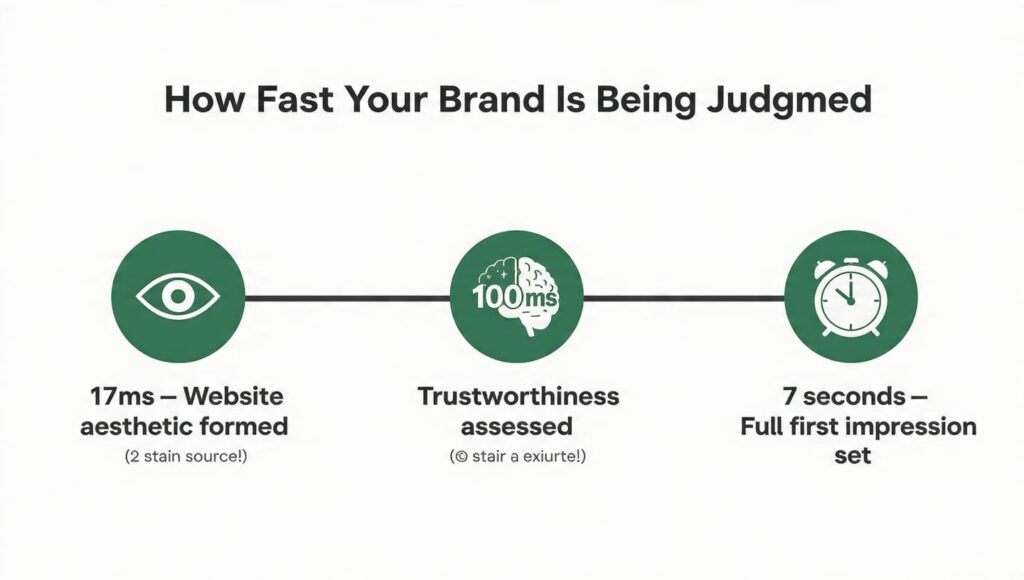
Research published by Princeton University found that people form first impressions of trustworthiness in as little as 100 milliseconds before a single word is read, before a price is checked, before any conversation happens. Your brand is being judged right now.
The question is: what verdict is it receiving?
The hidden brand judgment signals that customers respond to are mostly invisible to the business owner but completely visible to the buyer.
This article exposes exactly which nonverbal brand perception triggers are silently costing Nigerian brands trust, sales, and repeat customers every single day and what to do about each one.
1. The 100-Millisecond Verdict: How Fast Brand Judgment Actually Happens
Before a customer reads your bio, checks your prices, or watches your Reels, their brain has already completed a preliminary trust assessment. This is not opinion, it is neuroscience.
The limbic system processes visual and contextual cues faster than conscious thought, generating an immediate emotional verdict: trustworthy or not, professional or not, worth my time or not.
These split-second brand judgments are driven entirely by pre-interaction brand evaluation signs, signals your business sends without saying a word.
What triggers that instant verdict? Primarily: visual consistency, the quality of your first visible touchpoint (usually a website or social profile), and whether the overall presentation signals competence or carelessness.
A study by Google found that users form aesthetic opinions about websites in just 17 milliseconds, barely enough time for the page to fully load. So your customer first impression branding is not about your product quality or your pricing. It is about what they feel the moment their eyes land on your brand.
The implication is uncomfortable but important: you could have the best service in Lagos, the most competitive prices on the continent, and the most genuine care for your customers and still lose them in under a second because your visual clues are judging your business quality negatively before you ever get the chance to speak.
2. Your Website Is Speaking And Most Nigerian Brands Are Not Listening
The moment a potential customer lands on your website, that site is sending website signals customers judge immediately and mercilessly. Three of them matter more than everything else combined:
Page Load Speed
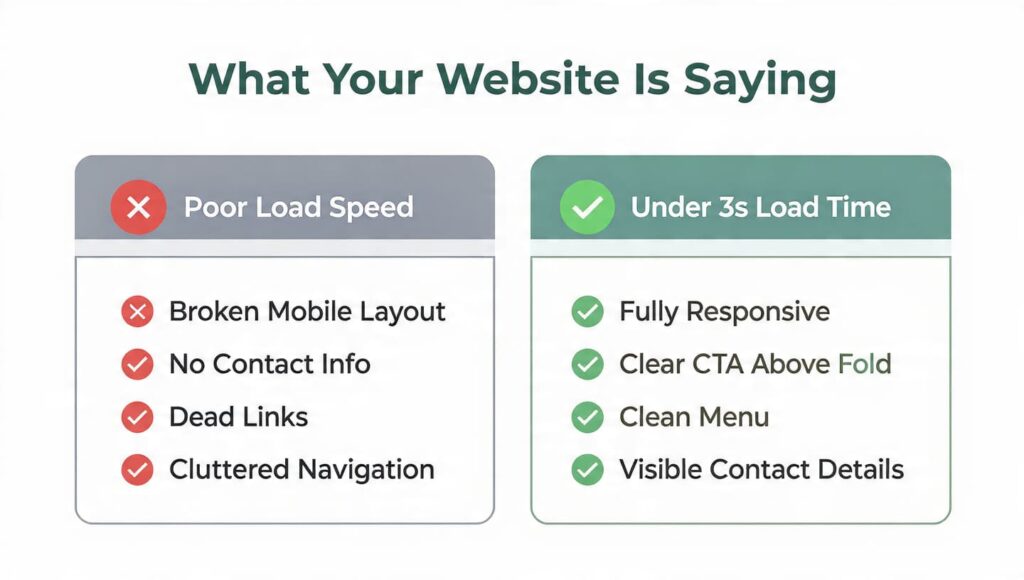
Slow site kills first impressions at a rate most business owners find shocking. Google’s Core Web Vitals research shows that 53% of mobile users abandon a site that takes longer than 3 seconds to load. For Nigerian users on variable mobile data connections, a heavy, slow website is the single most common silent conversion killer.
Every second of load delay costs an estimated 7% in conversion rates, per Akamai’s State of Online Retail. This is not a design problem, it is a website load time judgment that happens automatically, before you know they even visited.
Mobile Responsiveness
Mobile-unfriendly brand red flags are particularly damaging in Nigeria, where over 85% of internet traffic is mobile-first.
A website that renders broken menus, overlapping text, or requires pinch-zooming on a phone tells a customer one clear thing: this business does not understand its audience. That is a trust-destroying signal with zero words spoken.
Navigation Clarity
Poor navigation trust breakers include: no clear contact information, buried pricing, confusing menu structures, and pages with dead links.
Every time a customer cannot find what they came for, cluttered design customer turnoff activates and they associate that friction not with bad web design but with your brand’s reliability. The website experience is the brand experience for a digital-first customer.
This is exactly why building a high-converting website in Nigeria is not optional for serious brands in 2026 it is the frontline of your instant trust signals. A poorly built site is a pre-interaction brand evaluation that fails before the conversation even begins. See the most common website design mistakes Nigerian businesses make and how to avoid every single one.
3. Social Proof: The Invisible Credibility Score Every Customer Checks
Before a Nigerian customer buys from you, messages you, or walks through your door they have already checked your social media. They looked at your follower count. They scrolled your last five posts. They checked whether people are actually engaging with your content or if it is just silence.
This social proof brand perception check happens automatically, instinctively, and silently and most brands have no idea it is occurring.
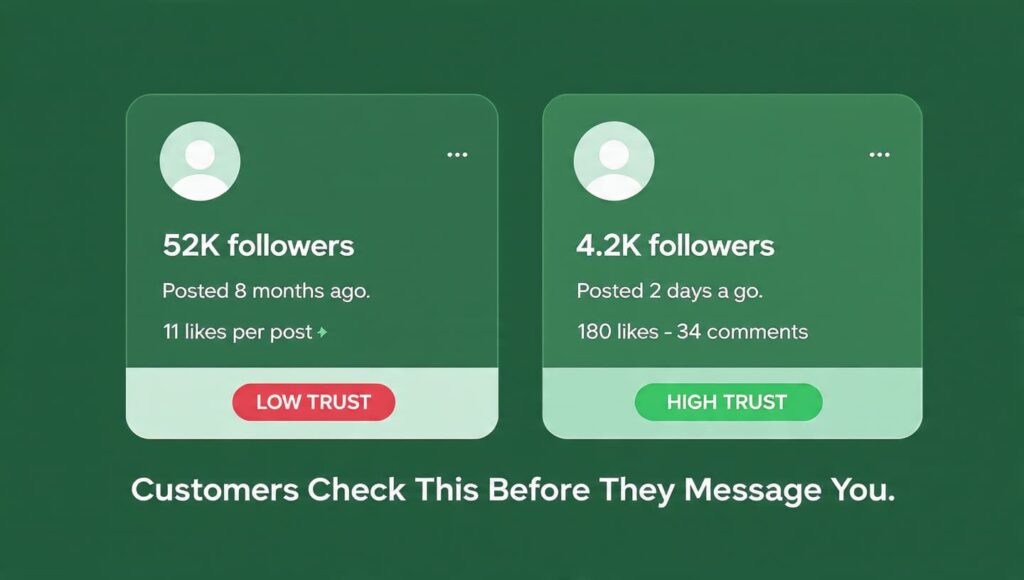
Fake followers expose weak brands faster than almost any other signal. An Instagram page with 50,000 followers and an average of 12 likes per post is not a credibility signal, it is a red flag. Customers, especially younger Nigerian buyers, are increasingly sophisticated about spotting inflated accounts.
The moment they notice the engagement-to-follower mismatch, your brand’s perceived legitimacy drops sharply.
Worth knowing: Real engagement, the kind that actually builds brand trust is what Sizzle Social is built around. Nigeria’s largest social media growth platform helps brands grow authentic reach across Instagram, TikTok, YouTube, and more without the fake follower trap. See how Sizzle builds real credibility
Inactive profiles hurt credibility just as much. A business Instagram that last posted in November 2023 tells the customer: is this brand even still operating? That uncertainty, that missing reviews flag risky brands energy is enough to push the customer toward a competitor who looks alive and active. Real engagement builds instant trust because it signals momentum: this brand is growing, this brand has customers, this brand is real.
Verified badges signal legitimacy on both Instagram and Facebook, but even without verification, a consistent posting schedule, genuine comment responses, and visible customer testimonials in your posts provide powerful unspoken brand quality indicators. Growing real Instagram followers is the foundation not vanity numbers.
4. Visual Branding Mistakes That Scream Amateur Quietly
You do not need a million-naira rebrand to fix visual branding mistakes customers spot. But you do need to understand which ones are quietly disqualifying your business in the customer’s mind before you know they are evaluating you.
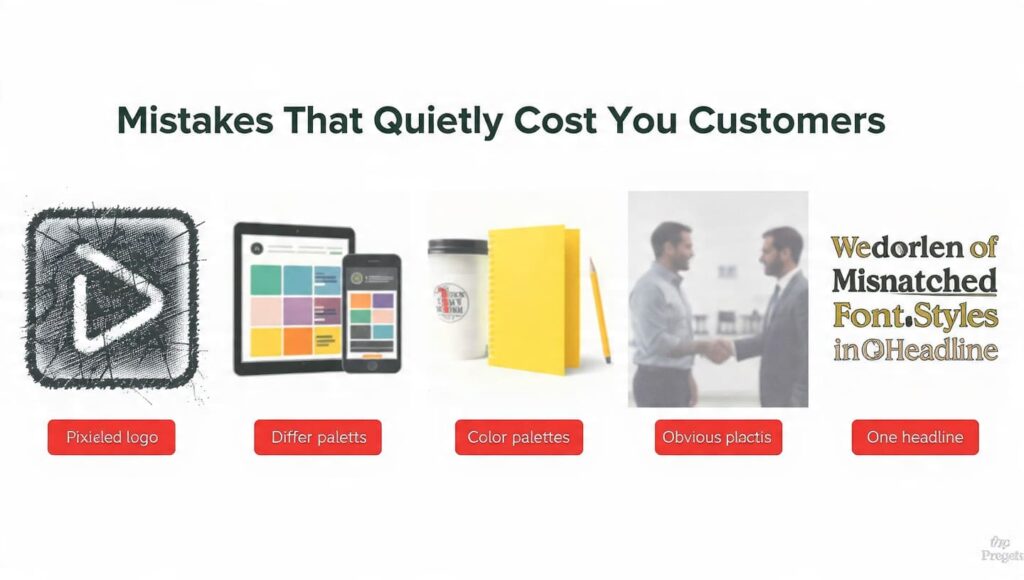
- Outdated logos scream unprofessional, not because old logos are inherently bad, but because a pixelated, stretched, or obviously dated logo signals that the business has not invested in itself recently. Customers infer: if they don’t care about their own presentation, will they care about mine?
- Inconsistent colors confuse customers, blue on Instagram, green on your website, red on your WhatsApp business profile. Every inconsistency dilutes brand recognition and subtly communicates disorganization. Brand consistency is not aesthetic vanity; it is cognitive trust-building.
- Blurry images kill brand trust faster than any negative review. In 2026, there is no excuse for low-resolution images on a brand page. A blurry product photo tells the customer the brand either does not take quality seriously or lacks basic attention to detail, neither impression is recoverable in a first interaction.
- Generic stock photos repel buyers because they are immediately recognized as placeholders. A brand that uses the same Shutterstock handshake image as every competitor has communicated nothing unique about itself. Real photos of your team, your workspace, your actual product, build initial brand credibility that stock photography never can.
- Mismatched fonts signal carelessness the same way typos do. Three different fonts across your website, social headers, and flyers create a subliminal sense of instability. A customer may not consciously notice the fonts, but they will feel the brand as disjointed, unpolished, and unreliable.
These are silent signals affecting purchases that operate entirely below the customer’s conscious awareness. They do not think: “this logo is outdated.” They think: “something feels off about this brand” and they leave. A professional website design overhaul is often the fastest single fix for multiple visual branding problems simultaneously.
5. Response Time and Digital Communication: The Judgment No One Talks About
Your customer messaged you on Instagram at 3pm on a Tuesday. It is now Thursday morning. You have not replied. To you, this is a busy week but to them, this is a pre-interaction brand evaluation and the result is: this brand does not value my time.
That judgment has already been made, and it will influence every future interaction they have with your business, if they even return.
Set up Instagram auto-replies, WhatsApp Business quick responses, and a clear response time window in your bio. “Replies within 2 hours” is not just a convenience note it is a nonverbal brand perception trigger that signals organization and professionalism.
The brands that win in Nigeria’s digital market are not always the most talented. They are the ones who show up consistently in every touchpoint a customer interacts with.
6. Your 5-Minute Brand Audit: Fix These Today
Run this checklist against your brand right now honestly:
- Website speed: Test your site at PageSpeed Insights. If your mobile score is below 70, your first impressions are bleeding customers daily. A website redesign focused on performance is worth every naira.
- Mobile rendering: Open your website on your own phone. Does it look professional? If it feels clunky, your customers felt that too. See what a conversion-optimized website looks like for Nigerian businesses.
- Social media activity: When did you last post? If it is over 2 weeks ago, your profile is quietly signaling abandonment and A consistent Instagram growth strategy fixes this directly.
- Engagement rate: Divide your average post likes by your follower count. Below 1%? Your social proof is working against you and you can Learn the smart way to increase Instagram followers without looking fake.
- Visual consistency: Do your Instagram, website, and WhatsApp Business use the same logo, colors, and font family? If not, investing in professional brand design is the most efficient trust upgrade available.
- Response time: Set a 2-hour reply goal. Enable auto-replies for after-hours inquiries. Every unanswered message is a silent brand judgment signal you will never see but your customer will.
The brands winning in Nigeria’s digital market in 2026 are not winning on product alone. They are winning on perception every touchpoint designed to send the right signal before a single word is exchanged. Fix the signals, and the customers follow.
Final Thoughts
Your customers are not waiting for you to pitch them. They are already deciding based on your visual branding, website performance, social proof, response time, and every other hidden brand judgment signal you may not even know you are sending. The silent verdict is constant.
The good news? Every signal in this article is fixable. A faster website, consistent visual identity, genuine social engagement, and a reliable response window are not expensive overhauls they are deliberate choices that compound into serious competitive advantage over time.
Need a starting point? Sizzle Social handles the social engagement side real growth, real credibility signals, across every major platform. And Sizzle Digital handles the website side. Between the two, your most critical customer first impression branding touchpoints are covered professionally.
Frequently Asked Questions
Hidden brand judgment signals are the non-verbal, visual, and behavioral cues that customers unconsciously evaluate before engaging with a brand. These include website load speed, logo quality, social media engagement rates, profile consistency, response time, and visual identity coherence across platforms. Unlike explicit brand messaging, these signals operate below the customer’s conscious awareness; they produce emotional impressions of trustworthiness, professionalism, or credibility without the customer articulating why they feel the way they do. Most business owners never audit these signals because they do not realize customers are reacting to them in real time.
Research from Princeton University shows that trustworthiness judgments form in as little as 100 milliseconds faster than conscious thought. Google’s research found that website aesthetic opinions form in approximately 17 milliseconds. A broader first impression is largely complete within 7 seconds of initial contact. This means that by the time a customer has consciously decided to evaluate your brand, their subconscious has already rendered a preliminary verdict. Positive or negative, this initial emotional impression colors every subsequent interaction including whether they stay on your website, follow your social page, or contact you.
Website speed is a direct proxy for brand competence in the customer’s mind. A slow-loading site creates immediate friction and signals that the brand either cannot afford proper hosting or does not prioritize customer experience. Google’s Core Web Vitals research shows 53% of mobile users abandon sites that take longer than 3 seconds to load. Beyond abandonment, slow sites also rank lower in Google search results, reducing discoverability. For Nigerian brands where mobile traffic exceeds 85%, a site that loads slowly on mobile data connections is actively costing customers every day it remains unfixed.
Fake followers create a visible engagement-to-follower mismatch that increasingly sophisticated customers recognize immediately. An account with 50,000 followers averaging 15 likes per post is a red flag the ratio makes artificial inflation obvious. This mismatch triggers distrust: if the brand is willing to fake its audience size, what else is being misrepresented? Beyond human perception, low engagement rates also hurt platform algorithms, reducing organic reach further. Authentic followers who genuinely engage with content provide social proof that builds real credibility, while inflated follower counts with no engagement do the opposite.
The most damaging visual branding mistakes are those that signal inconsistency or carelessness: pixelated or outdated logos that look unprofessional on modern screens, inconsistent color usage across platforms that confuses brand recognition, blurry product or team photography that signals low quality attention, generic stock photos that make the brand indistinguishable from competitors, and mismatched fonts across different touchpoints. Each of these mistakes individually creates minor friction. Combined, they produce a cumulative impression of a disorganized, low-investment brand and customers unconsciously associate that presentation quality with the quality of the product or service being offered.
Response time is one of the most directly measurable brand trust signals. HubSpot research found that 78% of customers buy from the brand that responds first not necessarily the cheapest or best. In Nigeria’s WhatsApp and Instagram-driven commerce culture, delayed responses are especially damaging because messaging platforms create an expectation of near-real-time communication. Every hour without a reply communicates that the business either did not see the message (disorganized) or saw it and deprioritized it (indifferent to customers). Both impressions are conversion-killers. Setting up auto-replies with clear response time expectations immediately upgrades brand professionalism.
Brand consistency across platforms builds what marketers call ‘cognitive fluency’ the ease with which customers recognize and recall a brand. When a business uses different colors on Instagram versus its website versus its WhatsApp Business profile, customers must mentally reconcile these differences on each visit. This creates subconscious friction and reduces brand recall. According to Lucidpress research, consistent brand presentation across all platforms increases revenue by an average of 23%. More practically: inconsistent branding signals to customers that the business lacks a coherent identity which translates to uncertainty about reliability and professionalism.
Social proof is the psychological phenomenon where people look to others’ behavior and opinions to guide their own decisions. For brands, it manifests as follower counts, engagement rates, customer reviews, testimonials, and user-generated content. When a customer sees that others are actively engaging with a brand’s real comments, visible reviews, high share rates, and responsive replies it reduces the perceived risk of purchasing. Missing or thin social proof, conversely, flags the brand as unproven or risky. For Nigerian consumers especially, peer validation through social media is a primary trust-building mechanism before purchase decisions are made.
The fastest improvements come from: (1) testing and fixing website load speed using free tools like Google PageSpeed Insights, (2) standardizing brand colors and fonts across all platforms using a simple brand style guide, (3) replacing any stock photography with real photos of your product, team, or workspace, (4) setting up WhatsApp Business and Instagram auto-replies to address the response time gap, and (5) posting consistently on social media at minimum 3 times per week to signal an active, living brand. None of these require large budgets; they require deliberate attention to how the brand presents itself digitally.
A professionally designed website communicates brand credibility in multiple dimensions simultaneously: fast load times signal technical competence, clean mobile-responsive design signals customer orientation, clear navigation signals organizational clarity, and high-quality visual design signals investment in quality. For Nigerian businesses where many competitors still rely primarily on social media without a proper website, having a fast, well-designed website creates an immediate competitive differentiation. It also provides a centralized credibility hub where social media profiles can direct potential customers to a space where the brand controls the entire first impression experience from start to finish.